

Icatnews // Shutterstock
Turn AI into results with this marketing AI ROI checklist
Industry analyses drawing on Gartner and other research suggest that a large majority of AI initiatives never deliver meaningful business results — some estimates put the failure rate at around 80%.
In this article, WebFX provides a scannable marketing AI ROI checklist designed to help your company become part of the minority that succeeds in their marketing AI initiatives.
When most AI programs stall before production or fail to move the needle on earnings, “let’s add AI” stops being a strategy. You need a problem-first rollout plan that connects every initiative to measurable ROI.
Are you a marketing manager who needs a practical, problem-first rollout plan? Or a director or CMO who wants to pressure-test AI investments, defend budgets, and prove impact? Read on for effective framework you can use to launch, measure, and scale your next AI initiative.
Why is it important to succeed at AI marketing?
It’s important to succeed at AI marketing because the upside is real, but only if you can prove it. Strong AI adoption can help teams:
- Increase conversion efficiency
- Reduce manual workload
- Make smarter decisions faster
ROI tracking is what turns those wins into something leaders can confidently scale. When you approach AI with a measurement plan from day one, it becomes easier to prioritize the right projects, defend spend, and build momentum across the department.
Recent research based on Gartner’s data shows that many AI projects never make it into production or fail to create a measurable earnings impact — meaning only a minority of companies are seeing real value from their AI investments so far.
For marketing leaders, this creates a simple requirement: You need ROI visibility early. Not at the end of the year. Not after you’ve bought five tools. Early enough that you can cut out weak experiments and double down on winners.
McKinsey’s research backs up the same theme. They stated that value tends to emerge when companies clearly define their AI vision and strategy, invest 20% of their digital budgets in AI-related technologies, and employ data scientists to run algorithms that optimize marketing and sales. This works because they consider business problems that need solving before choosing to adopt AI.
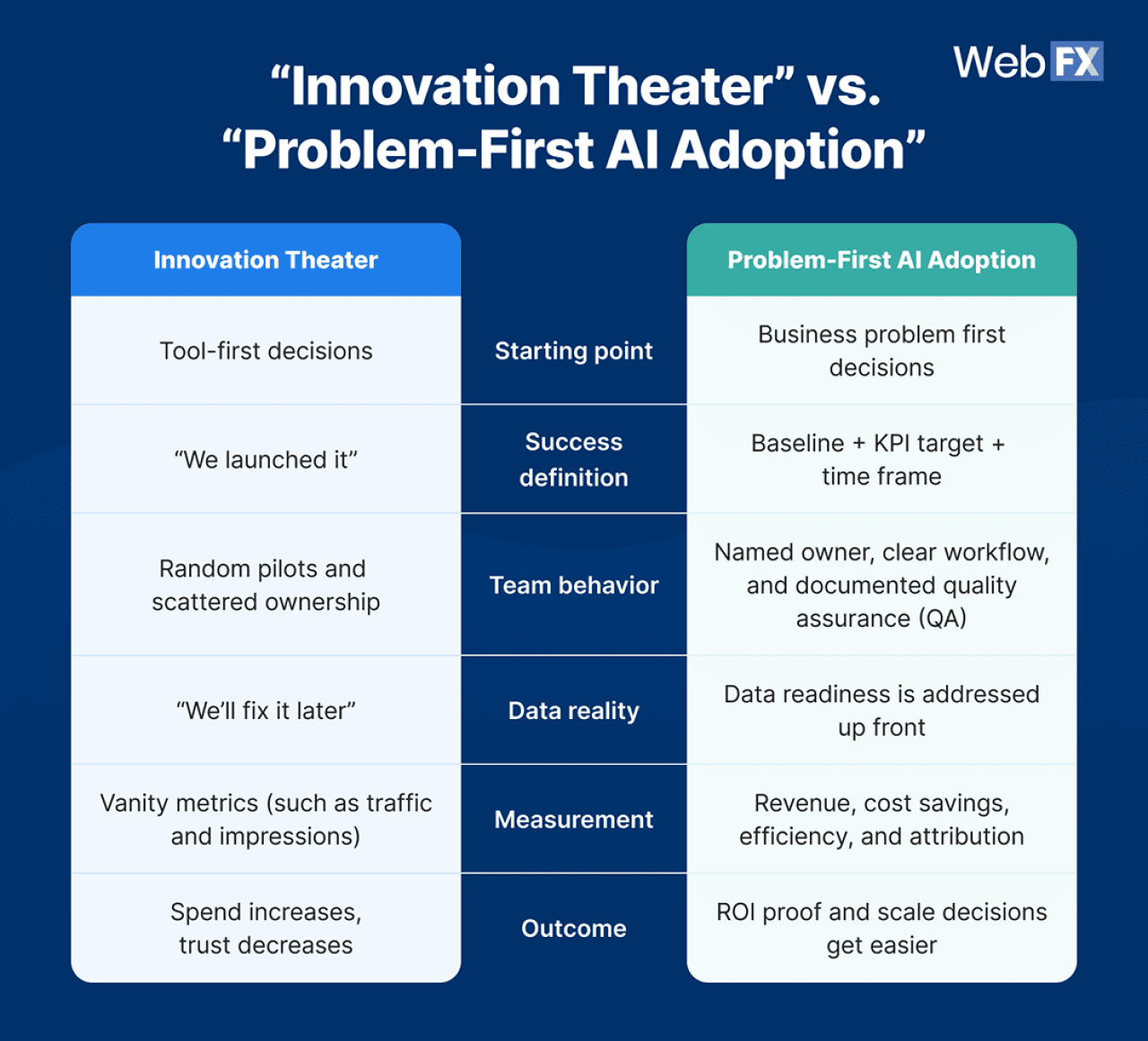
Here’s a quick look at the difference between a company that simply wants to innovate and a company that wants to solve a problem.
WebFX
AI doesn’t fail because it’s “not powerful enough.” It fails because teams can’t connect it to measurable business outcomes. And when budgets tighten, anything unprovable gets labeled a bad investment.
7 Marketing AI automation strategies to maximize ROI
If you’re building a marketing AI plan right now, you’ll want to start with high-effort, repeatable tasks that affect performance or efficiency across campaigns. Here are a few practical strategies that you can apply across the marketing funnel:
- AI-assisted content creation: AI-assisted content creation enables you to generate first drafts, refresh existing content, and personalize messaging across channels with human oversight to protect quality and brand voice.
- Predictive analytics: Predictive analytics is how marketing teams forecast customer behavior and conversion likelihood so they can allocate budget and effort before performance drops.
- Email marketing optimization: Email marketing optimization is the use of automation to improve timing, sequencing, and message relevance, so campaigns earn higher opens, clicks, and downstream conversions.
- Ad management: In ad management, AI supports automated bidding, real-time optimizations, and tighter targeting so you reduce budget waste and react faster to performance shifts.
- Automated lead scoring and nurturing: Automated lead scoring and nurturing is a system that prioritizes high-intent leads and triggers personalized follow-ups, so sales can focus on the right conversations.
- Hyper-personalization at scale: Here, AI serves content, recommendations, and offers based on individual behavior rather than broad segments, which typically improves engagement and conversion rates.
- Conversational chatbots: Conversational chatbots are an always-on layer for support, qualification, and routing that reduces response time and improves customer experience without adding headcount.
A 3-point checklist for marketing AI ROI
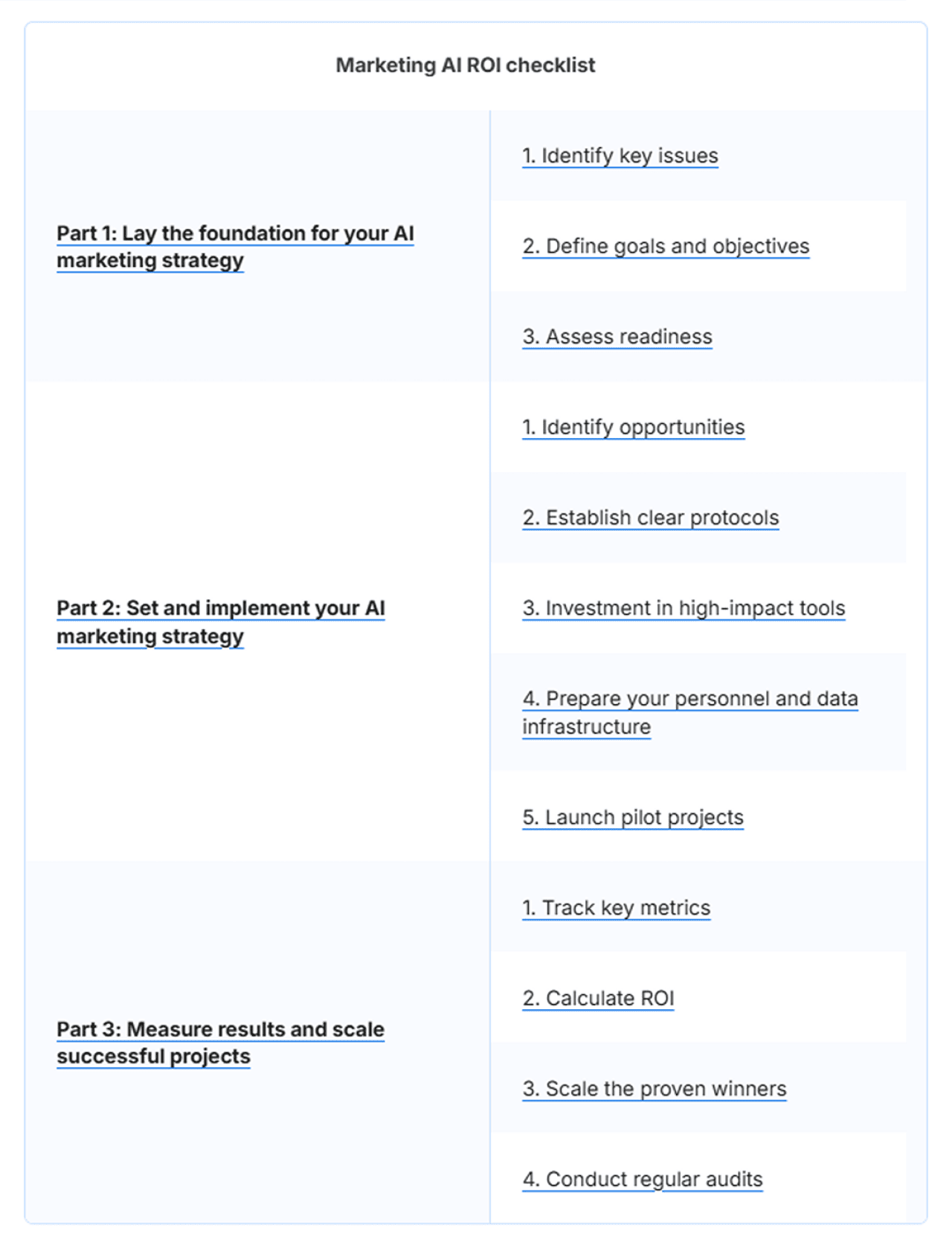
If you’re looking for a checklist for marketing AI ROI that you can actually use (and defend internally), here it is.
This 3-point marketing AI implementation checklist is designed to reduce risk by forcing clarity early. You’ll start with measurable problems, build with ROI metrics, and scale only after you’ve proven impact.
WebFX
1. Lay the foundation for your AI marketing strategy
This phase helps you connect AI to a real business outcome before you invest time, budget, and team attention. It also serves as an AI-readiness checklist for marketing, allowing you to confirm that your data, tools, and team are prepared.
1. Identify key issues
This is a crucial step that allows you to get specific about what needs to improve before you bring AI into the picture.
Start by pulling baseline numbers for the area you want to optimize, such as how long key tasks take, what they cost, and what results they produce in conversions, lead volume, and lead quality. Then compare that baseline to your historical performance and relevant industry benchmarks to spot where you’re underperforming or leaving revenue on the table.
Once you see the gaps, choose one high-impact problem to solve first. This might be tightening your channel mix, so you invest more effort into the channels that reliably drive revenue. It might also be prioritizing conversion rate optimization so you can turn existing traffic into more leads by identifying what’s working, what isn’t, and what needs to change.
2. Define goals and objectives
Set goals that are specific, time-bound, and tied to a business outcome, such as increasing lead volume, improving lead quality, raising conversion rates, or reducing campaign production time. The clearer your target is, the easier it is to choose the right AI workflow and prove whether it worked.
To make the goal actionable, define what success looks like in plain terms and document it before you start. This is also where you decide how you’ll report results, so your stakeholders aren’t debating what “better” means later.
Here are a few examples of specific and time-bound goals you can set:
- Revenue and pipeline goal example: Increase marketing-qualified leads by 15% in the next 90 days compared to the previous 90 days, measured in your CRM.
- Efficiency goal example: Reduce average campaign production time by 20% this quarter, measured by days from brief approval to launch in your project management system.
- Performance goal example: Increase landing page conversion rate from 2.5% to 3.0% within 60 days, verified through A/B testing and analytics goal tracking.
- Quality goal example: Reduce content QA revisions by 25% over the next 90 days, as measured by the average number of revision rounds per asset, while maintaining brand and compliance standards.
3. Assess readiness
This is where you confirm your environment can support AI without creating friction for your team. A readiness check keeps implementation smooth, protects data quality, and helps you choose tools that fit your current systems instead of forcing a rebuild. It also sets expectations for what needs to happen before a pilot goes live, which saves you time later.
Focus on these areas to assess how ready your company is to implement AI:
- Data readiness: This involves confirming whether your data is accurate, consistent, accessible, and secure enough to support the AI use case you want to implement.
- Tech stack fit: Check whether your current tools can integrate with AI workflows, including your CRM and marketing automation systems.
- Process readiness: Identify where AI will fit into the workflow, who is responsible for quality control, and what “done” looks like.
- Team readiness: Confirm whether your team understands the purpose of the initiative, has received baseline training, and has the time and ownership necessary to adopt the workflow.
2. Set and implement your AI marketing strategy
Now that you know what you want to improve and how you’ll measure success, you can start building your program in a way that’s easy to adopt and easy to evaluate.
This phase is about choosing the right workflows, setting clear guardrails, preparing your team and data, and launching pilots that produce clean results you can actually scale.
1. Identify opportunities
Select the specific marketing workflows that AI should initially support. Prioritize repetitive tasks that require significant time, create bottlenecks, or impact performance across multiple campaigns. When you pick opportunities that are frequent and measurable, you get faster learning and clearer ROI signals.
Start by mapping where your team spends time today and where delays or inefficiencies show up most often. Then narrow your first use cases to the ones that are easiest to measure and most likely to impact core goals.
If you’re evaluating several options, use a simple shortlist:
- Workflow volume: Select tasks that happen often enough to create measurable time savings and performance impact.
- Business impact: Prioritize tasks that influence conversions, lead quality, revenue, or customer experience.
- Measurement clarity: Choose workflows where you can track before-and-after performance with minimal noise.
- Implementation effort: Start with use cases that don’t require major system changes to test.
2. Establish clear protocols
Make sure that you protect quality, trust, and brand consistency while your team adopts AI. Protocols give people a clear standard for what’s allowed, what needs review, and how to handle sensitive data. They also reduce the back-and-forth that can slow adoption, because everyone knows what “good” looks like.
At a minimum, document how your team will handle review, compliance, and voice. Keep it simple enough to follow daily, but clear enough that leadership feels confident the program is controlled.
If you need a quick protocol framework, include:
- Brand and voice guidance: Define what AI can draft, what needs editing, and what must be written or approved by a human.
- Data privacy rules: Clarify what data can be used in prompts and tools, and what data is off-limits.
- Quality checks: Set standards for accuracy, sourcing, claims, and required review steps.
- Ownership: Assign the person responsible for output quality, approvals, and workflow compliance.
3. Investment in high-impact tools
Select tools that match your highest-priority workflow instead of buying broad platforms that don’t get used. Choose tools based on your goal, your readiness assessment, and your integration needs. A well-chosen tool makes adoption easier because it aligns with your current process and eliminates unnecessary steps.
This is also where you set yourself up to calculate ROI cleanly. Track every cost from day one, including licensing, subscription fees, integration work, and any new support needed.
Centralized tracking during this phase makes reporting easier because cost inputs and performance baselines are already documented.
4. Prepare your personnel and data infrastructure
Training and data preparation help your team build confidence quickly, and they reduce the “friction costs” that can quietly eat ROI. When you invest here up front, pilots run faster, results are cleaner, and scale is less disruptive.
Treat prep as part of the ROI plan, not a separate task. Track the time spent on training, documentation, data cleanup, and implementation, because those are real inputs to the ROI calculation.
To make this step actionable, focus on:
- Role-based training: Train each team on the workflows they will own, so adoption is practical, not theoretical.
- Workflow documentation: Write simple process steps, so people can repeat the workflow consistently.
- Data cleanup and access: Organize, secure, and standardize the data the AI tool will rely on.
- Measurement setup: Confirm whether you can track the right KPIs through your CRM and reporting systems from the start.
5. Launch pilot projects
Test AI in small parts to learn quickly and build proof before you scale. A strong pilot gives you clean insight into what improved, what didn’t, and what needs adjustment. It also gives leadership confidence because the rollout is controlled and measurable.
Set a tight pilot scope, define success criteria up front, and run it long enough to see a real signal. Then document what changed and why, so you can repeat it in the next workflow.
Here is a simple pilot structure to consider:
- Scope: Choose one workflow and one team to start with, so results are easier to isolate.
- Success criteria: Set the exact targets you expect to hit, such as time saved, conversion lift, or improved lead quality.
- Workflow integration: Connect AI outputs to your existing systems, such as CRMs and marketing automation systems, so the pilot fits daily work.
- Feedback and iteration: Collect feedback during the pilot and update prompts, processes, and review steps as needed.
3. Measure results and scale successful projects
Now, you can scale your AI initiative into reliable growth. When you track the right metrics, calculate ROI correctly, and scale only what’s proven, you build momentum and protect budget at the same time.
1. Track key metrics
Monitor performance using a defined time frame so you can see whether the AI initiative is creating real change. Choose a tracking window that fits your workflow, such as 30, 60, or 90 days, and use rolling averages so you’re not making decisions based on short-term spikes. Keep your report consistent, so stakeholders can quickly understand the impact.
To keep this actionable, align metrics to the goal you set in Point 1 and track a mix of outcomes and efficiency. A centralized reporting approach makes it easier to connect AI-driven activity to leads, pipeline, and revenue across channels.
If you’re tracking multiple metrics, keep them grouped:
- Financial metrics: This can include conversion rate, cost per lead (CPL), cost per acquisition (CPA), return on ad spend (ROAS), customer lifetime value (CLV), and other cost-to-outcome signals.
- Revenue metrics: This includes metrics like leads, conversions, sales, and pipeline outcomes tied to marketing activity.
- Engagement metrics: This involves click-through rate (CTR), lead quality indicators, retention rate, and signals that support downstream conversion.
- Efficiency metrics: These metrics might include time saved, output volume, speed-to-launch, and faster lead response times.
- Strategic metrics: This can include brand perception, competitive benchmarking, and speed-to-market improvements.
2. Calculate ROI
Turn performance changes into a number that leadership can use to make budget decisions. Use one consistent formula, define your time frame, and document what you included in costs and gains. This makes ROI easier to defend because your math is clear and repeatable.
Use this formula to calculate ROI and apply it to a defined period:
(Revenue Gains + Cost Savings − Total AI Costs) / Total AI Costs × 100%
To keep ROI clean, use attribution models and A/B testing where possible so you’re estimating AI’s contribution, not just reporting overall marketing performance. This is also where it helps to separate “time saved” from “value created” by tying saved time to increased output, improved speed, or cost reduction.
3. Scale the proven winners
Now, you can expand what worked and turn it into a repeatable program. Scaling involves expanding the same proven workflow into similar campaigns, teams, or channels while maintaining the same measurement standards. This approach protects ROI because you’re not guessing what will work next.
Document what made the pilot successful, including the workflow steps, review process, and reporting method. Then scale in stages so you can maintain quality as volume increases.
4. Conduct regular audits
Quarterly audits help you spot what needs refinement, what deserves more investment, and what should be discontinued. They also help you maintain compliance, data standards, and quality controls as tools and policies evolve.
Ensure your audit includes both performance-focused and governance-focused objectives. Consider reviewing the results, reallocating the budget based on what has proven effective, and confirming that data use and outputs still meet your standards for accuracy, privacy, and brand consistency.
This story was produced by WebFX and reviewed and distributed by Stacker.

